

Against the backdrop of the rapid development of new energy storage, electrical assembly, automation equipment, and precision instrument industries, precision sheet metal processing is no longer merely about simple cutting and bending. High-end clients - energy storage leading enterprises, complete electrical equipment manufacturers, and automation equipment research and development companies - have long moved beyond the superficial stages of comparing prices, looking at equipment, and examining samples when choosing sheet metal suppliers. What they truly seek is a long-term technical partner capable of simultaneous R&D, stable tolerance control, traceable process, and closed-loop handling of anomalies.
Many sheet metal factories have adequate equipment and impressive sample production results, but they often struggle to be included in the qualified supplier list of high-end clients. The core reason lies in the fact that trust is not established through a single beautiful sample, but rather accumulates gradually through standardized, verifiable, and consistently consistent delivery capabilities. This article, based on the local precision sheet metal supporting scenarios, dissects the underlying demands of high-end clients and shares the path for precision sheet metal enterprises to build professional trust.
1. Trust Starting Point: Transition from "Order Processing" to Pre-DFM Collaboration, Understanding the Risks Behind the Drawings
When ordinary sheet metal factories receive drawings, they directly start production; for high-end clients, the sheet metal service provider they require is a process partner that can participate in the early design review. High-end project drawings often have strict tolerances, IP protection, electromagnetic shielding, heat dissipation, sealing, grounding, and other combined requirements. Many design flaws are difficult to be intuitively discovered on the three-dimensional drawings: the R-angle of the bending is too small, the distance between the hole position and the bending line is too close, the weld deformation will damage the sealing plane, the assembly interference caused by the stacking tolerance of the sheet metal, and the mismatch of aluminum plate / stainless steel material selection in the bending process.
A reliable precision sheet metal team, upon receiving the client's drawings, immediately initiates DFM manufacturability review:
Distinguish between critical dimensions and general dimensions, make tolerance allocation to avoid tolerance accumulation;
Based on the material (5052 aluminum plate, 304 stainless steel, high weather-resistant galvanized plate), provide suggestions for bending rebound and minimum inner R optimization;
For high protection enclosures with IP54, IP65, etc., evaluate the sealing groove, drainage structure, continuous full welding scheme;
From the comprehensive perspective of processing, welding, painting, and assembly, propose cost reduction and yield improvement plans without affecting the equipment function.
This review report is the first step in establishing trust with high-end clients. Clients will intuitively feel that this factory understands the structure and knows the working conditions requirements, rather than just "processing according to the drawings". Especially for energy storage and outdoor electrical control projects, with the special coastal salt spray environment, communicating the pre-communication of anti-corrosion and sealing risks in advance is much more likely to gain client approval than remedying problems after mass production.
2. Trust Foundation: Autonomous Control of Core Processes, Rejecting Layered Subcontracting
The supply chain review of high-end clients is most vigilant about "shell-style order taking, full process outsourcing and subcontracting". Once laser, bending, welding, painting, and assembly are distributed to different outsourcing factories, the standard transmission of the drawings will be attenuated, batch color differences, weld quality fluctuations, and size drift are inevitable results, and the responsibility boundary is ambiguous when traced.
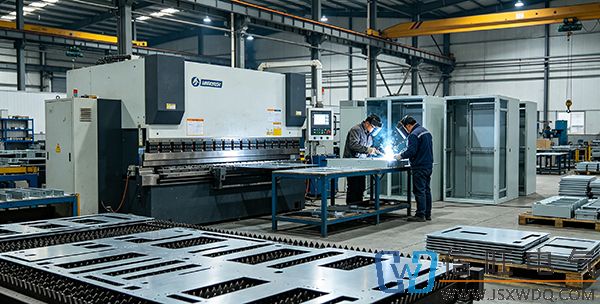
To establish a firm position in high-end supporting, the core processes of precision sheet metal must be closed-loop self-control: ✅ High-precision laser cutting: stable control of cutting burrs and heat affected zone, meeting ±0.1mm contour accuracy; ✅ CNC bending unit: equipped with seamless molds, rebound compensation program library, independent process parameters for stainless steel and aluminum plates; ✅ Automated welding station: robot welding, argon arc welding, post-welding repair welding, achieving continuous full welding for the sealing box, controlling welding deformation; ✅ Own pre-treatment + electrostatic powder coating line: independently control degreasing, phosphating, passivation, and baking, stably implement Pantone color number, film thickness, masking specifications, and adapt to outdoor high-salt spray powder; ✅ Independent quality inspection station: calipers, angle rulers, paint film thickness gauge, water test fixture, three-coordinate detection tools are equipped.
It is not that outsourcing is completely unusable, but it must be controllable, with a very low proportion, and incorporated into a unified quality inspection standard. When high-end customers conduct factory audits, they will focus on verifying the production line layout, process flow cards, tooling and fixtures, and first-piece records; an autonomously closed production line is the hardware support for all quality commitments.
III. Trust Certificates: Standardized inspection and complete traceability, all indicators are "traceable"
One common feature of high-end equipment customers: all quality requirements need to be documented, and oral guarantees are not accepted. For ordinary orders, only delivery is made; for high-end precision sheet metal deliveries, a complete set of quality documents is attached to the goods: material quality certificates, spectroscopy reports, first-piece FAI test reports, process inspection records, salt spray test reports, paint film thickness records, batch identification.
The complete traceability system includes the following contents:
Raw material entry control: plate grade, furnace number, batch records, to prevent the misuse of hard materials;
First-piece confirmation mechanism: for new products, batches of changed plates, changed powder, adjusted bending parameters, must conduct full-size testing of the first-piece, signed and sealed by the customer, as the batch benchmark;
Process inspection: sampling at each node of cutting, bending, welding, spraying, record dimensions, appearance, sealing performance;
Special finished product testing: water-tight box for water / air pressure tests, color difference comparison of appearance parts, grounding conductivity test;
Batch identification management: each batch of workpieces has a unique identifier, in case of abnormalities, it can be quickly located to the raw materials, operators, equipment, and production time.
Many projects for energy storage battery boxes and outdoor charging station shells have customers who conduct regular audits (supplier audits). A set of standardized and accessible traceability materials is the most obvious sign that distinguishes ordinary processing plants from precision sheet metal suppliers.
IV. Trust Bonus Points: Small-batch flexible R&D support, accompanying customer new product iterations
High-end customers' large demands are concentrated on new product R&D prototypes, small-batch trial production, and iterative modifications, rather than simple millions-level large orders. Many sheet metal factories only prefer large orders, considering prototype production troublesome, low profit, many changes, and slow response, which is precisely the reason for missing high-end customers.
The service capability of precision sheet metal is reflected in the full-cycle support for NPI new product introduction:
Fast prototype production, short-term delivery, cooperation with R&D testing;
Clear version management of drawings, each change records version numbers to avoid mixing new and old versions;
After prototype testing finds assembly, sealing, and heat dissipation problems, quickly synchronize process adjustment plans;
Support from a few prototypes, dozens of small tests, smooth transition to batch production, simultaneous migration of process documents, tooling, and inspection standards, without re-acclimation.
For automation and energy storage R&D enterprises, a reliable sheet metal factory is equivalent to an external process department. Being able to keep up with the R&D rhythm, understanding the iterative logic, and long-term cooperation in new product implementation, it is easy to form a deep bond.
V. Trust Fortress: Active closed-loop handling of abnormalities, rather than waiting for customers to complain
Even the most mature processes cannot achieve zero defects. High-end customers evaluate suppliers not only by the pass rate, but also by the abnormal handling mechanism. Low-end model: when customers report problems, they first defend, find reasons, and shift blame; high-end cooperation model: upon receiving abnormal feedback, immediately suspend the batch, isolate the defective parts, conduct internal root cause analysis, output 8D improvement reports, including problem description, cause location, temporary containment measures, long-term improvement plans, verification records, and prevention mechanisms.
VI. Local Advantage: Transform regional supporting advantages into trust advantages
The integration of energy storage, photovoltaic, charging station, and electrical control complete chain industries is the unique advantage of local precision sheet metal. Making good use of this advantage is easier to win customer trust:
Geography proximity, supporting customers to conduct factory audits, on-site sample viewing, and joint trial assembly; When encountering problems, quick on-site coordination can be carried out, and the communication cost is much lower than that of suppliers from other regions.
Familiar with the local project conditions, deeply understanding the erosion risks of high humidity and salt spray in offshore areas on sheet metal corners, weld seams, and powder coating layers, the process plans are more in line with the actual implementation scenarios.
Familiar with industry standards, module requirements, and grounding specifications for GGD, GCS, Viitoru cabinets, energy storage battery boxes, and inverter shells, reducing a large amount of upfront communication costs.
Nearby prototyping, quick re-ordering, and turnaround for repairs are fast, meeting the rush production needs of equipment enterprises' projects.
However, localization does not mean inherently reliable. Only by combining local convenience with stable processes, standardized quality control, and transparent services can geographical advantages be transformed into long-term cooperative trust.
The trust of high-end customers in precision sheet metal suppliers is never packaged through marketing rhetoric. It comes from professional DFM reviews at the drawing stage, from the autonomous control of core processes, from traceable detection data for each batch, from stable flexible delivery during new product iterations, and from responsible closed-loop capabilities during quality abnormalities.
For precision sheet metal processing enterprises, price is only the entry threshold. Consistency, verifiability, collaboration, and traceability are the core criteria for choosing partners in the high-end supply chain. Breaking away from the positioning of "sheet metal is just processing", transforming into a process collaboration partner for downstream equipment enterprises, continuously and stably fulfilling each delivery commitment, can continuously win the long-term trust of high-end customers in energy storage, electrical, and automation, and establish differentiated competitiveness in the regional sheet metal market.
Contact
Be the first to know about our new product launches, latest blog posts and more. Jiangsu Xinwang Electric Co., Ltd. was founded in March 2013 with a registered capital of 10 million yuan. Its registered address is No. 3, Chuanyang Road, Development Zone, Funing County, J... Any question or request?
Click below, we’ll be happy to assist. Contact
扫码咨询
友情链接:PDS863液位变送器 食品废水气浮机 ABB继电器 高效液相色谱 可视化大屏
声明:本站部分内容图片来源于互联网,如有侵权尽早时间联系管理员删除! Email:www@jsxwdq.com
Copyright © 2025-2026 Jiangsu Xinwang Electric Co., Ltd. All Rights Reserved. 苏ICP备2026037747号-1